












Best Portable Power Stations for Power Outages: How to Choose
Most outages are over before the ice in the freezer melts. The ones worth preparing for are the exceptions, and they're why a portable power station deserves a corner of the house in the first place. Most buying advice starts with a product list and works backwards, which is how people end up with a 500Wh unit for a refrigerator or a 3,000W inverter whose main job is charging two phones.
This guide starts where the outage does: with what you refuse to lose. Tally those loads, make sure the inverter can start them, and know how you'll recharge if the grid is still down on day two. Get those three right and the choice of a portable power station for power outages pretty much makes itself.

Start With What You Need to Run
Three questions settle the purchase: what must keep running, for how many hours, and how much power it pulls at the moment it starts.
| What you want to keep running | Typical running draw | Energy over a 12-hour outage |
|---|---|---|
| Phones, Wi-Fi router, a few LED lights | 20–60W | 250–500Wh |
| Full-size refrigerator, nothing else | 100–400W while the compressor runs | 600–1,000Wh |
| Refrigerator, router, lights, CPAP | 200–450W | 2,000–3,000Wh |
| Refrigerator, freezer, well pump, microwave | 800W+ | 4,000Wh and up |
Refrigerators decide the purchase for most people, and they are the easiest appliance to get wrong. A modern full-size unit draws 100–400W while its compressor runs, but the compressor runs only 30–40 percent of the time, averaging 50–60W and 1 to 2kWh a day. What breaks a small station is not that average. It is the second or two when the compressor kicks on and pulls three to five times its running wattage.
Measure Your Own Loads Instead of Guessing
The EnergyGuide label lists annual kWh. Divide by 365 for the daily figure. For startup draw, find the compressor’s locked rotor amps on the appliance label and multiply by 120 volts. A plug-in power meter on the fridge for a day removes the guesswork.
What to Look For in a Portable Power Station for Power Outages
Capacity Tells You How Long, Output Tells You What
Watt-hours are the tank; watts are the pipe. A unit can hold 2,000Wh and still refuse to start your refrigerator if its inverter cannot cover the surge. Subtract about 15 percent for inverter losses before dividing by the load, so a 2,048Wh station leaves roughly 1,700Wh to spend.
The Startup Surge Is the Spec That Trips People Up
Refrigerators, freezers and well pumps all have motors. A fridge running at 150W can spike to 700–900W for one to three seconds, and an older or larger unit can reach 1,800W. A station rated at 1,000W will run a fridge it cannot start. Pure sine wave output matters for the same reason: compressors and medical devices expect the grid’s waveform.
Battery Chemistry Decides How Many Outages It Survives
LiFePO4 is the default for backup use, and cycle life is the reason. A pack rated at 3,000 to 4,000 cycles still holds most of its capacity after a decade of occasional discharge, while older lithium-ion chemistries manage a fraction of that and tolerate heat less well.
Recharging Is What Gets You Through the Second Day
AC speed matters because restoration windows can be short. If the grid returns for forty minutes, a unit that refills in two hours banks far more than one that needs six.
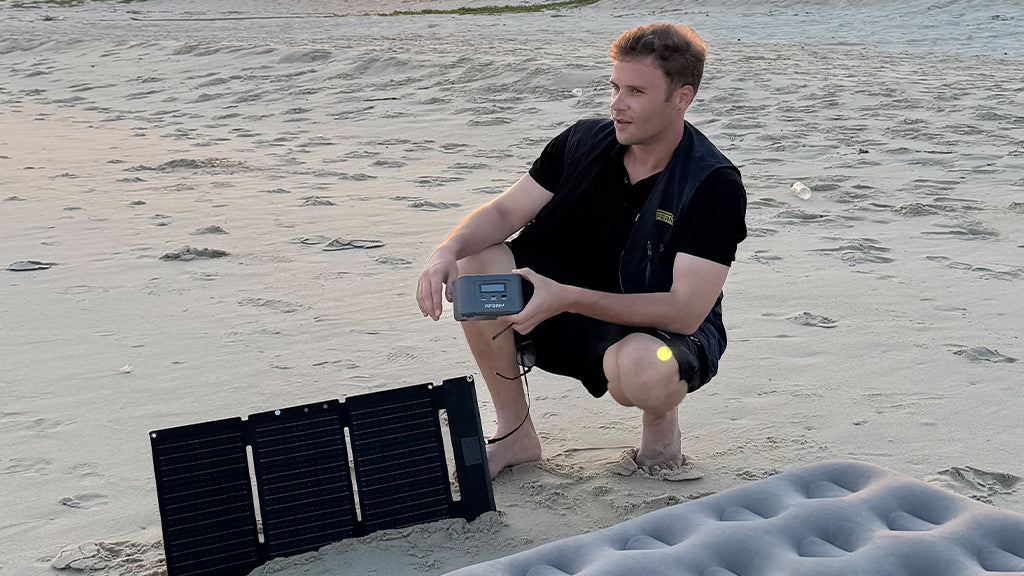
Solar is the other half, and the number printed on the panel is not what reaches the battery. Estimate panel watts × peak sun hours × 0.7. Peak sun hours are not daylight hours: much of the northern US sees about 2.5 in December, against 5 or more in Phoenix, so a 400W panel in a New York January delivers roughly 700Wh a day and the same panel in Arizona nearly double. Left flat on the ground in winter, a panel gives up another 25 to 35 percent.
Best Portable Power Stations for Power Outages
| Model | Capacity | Continuous output | Max solar input | Recharge | Expandable to | Best for |
|---|---|---|---|---|---|---|
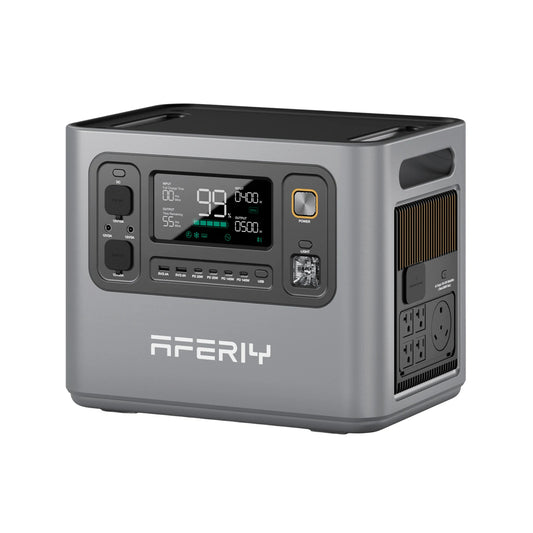
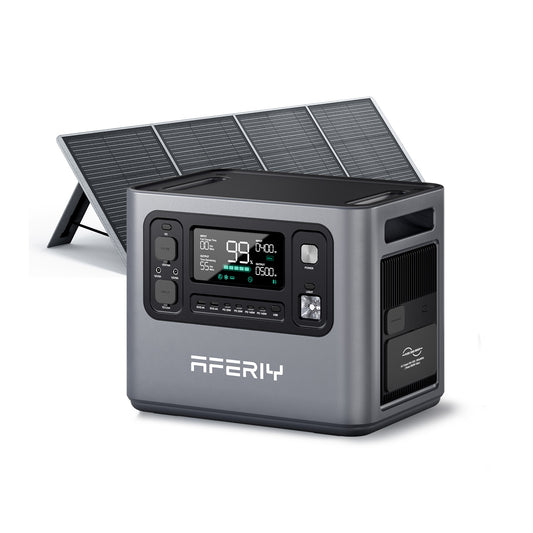
| AFERIY P210 Portable Power Station | 2,048Wh | 2,400W | 500W | 0–100% in about 2 hours on AC | Not expandable | Most households, short to medium outages |
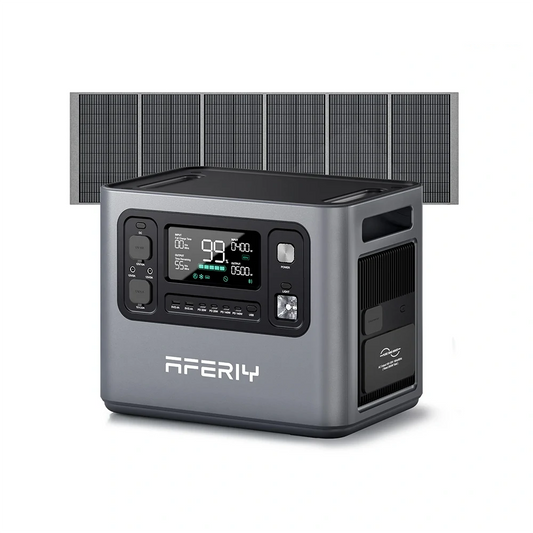
| AFERIY P300 Portable Power Station | 2,048Wh | 3,000W | 1,200W | 80% in 55 min, 0–100% in 1.1 hours on AC | 10,240Wh | High-draw appliances, room to grow |
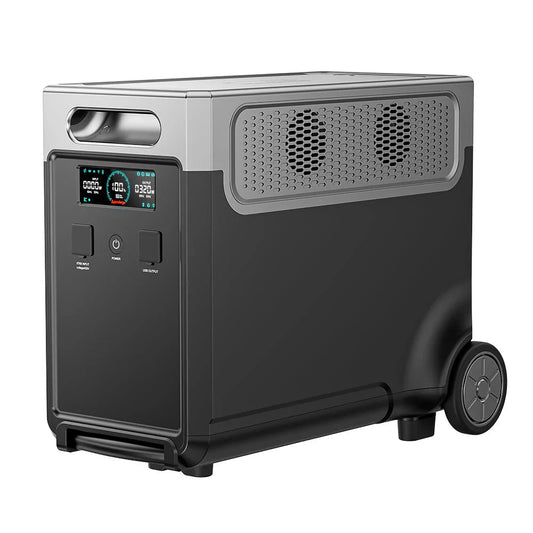
| AFERIY P310 Portable Power Station | 3,840Wh | 3,600W | 2,000W | 80% in about 1.5 hours on AC plus solar | 11,520Wh | Multi-day outages, larger homes |
Best Overall for Most Households: AFERIY P210 Portable Power Station
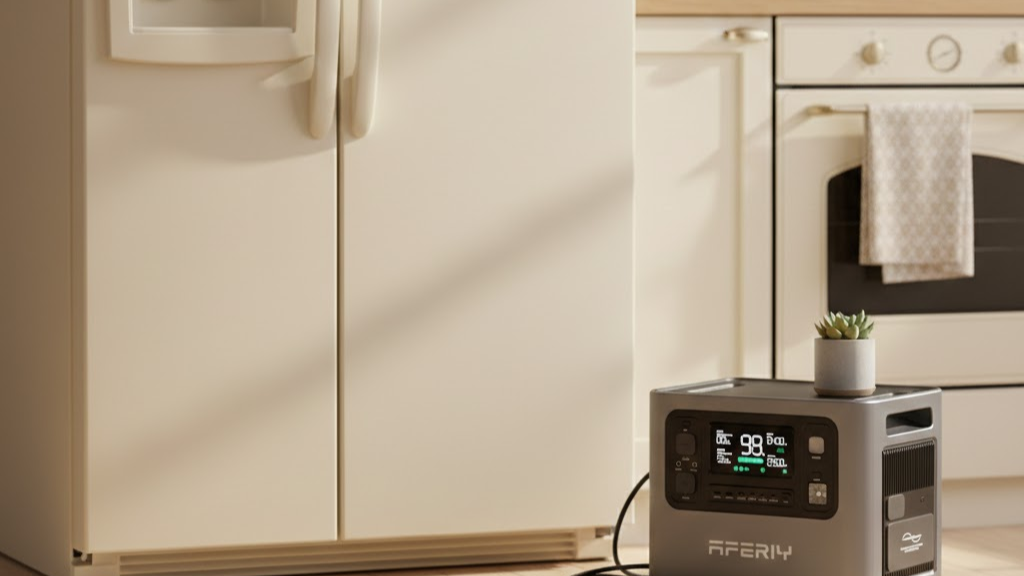
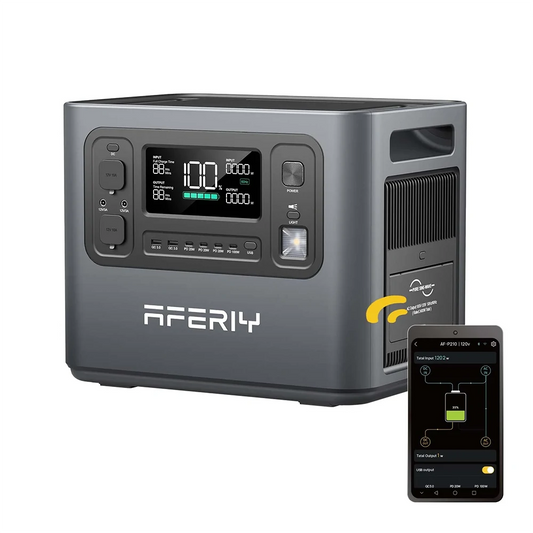
For many homes the question is not capacity but whether the unit can sit inline with the devices nobody wants to reset. The AFERIY P210 Portable Power Station stores 2,048Wh in a LiFePO4 battery and delivers 2,400W of pure sine wave output across 16 outputs. Its UPS switches in under 10 milliseconds, so a router or desktop never drops, and 2,400W starts a full-size refrigerator rather than only running one.

Best for High-Draw Appliances and Room to Grow: AFERIY P300 Portable Power Station
The gap the P210 leaves is output. A well pump, a microwave and a refrigerator can ask for more than 2,400W at once, and a pump’s surge is harsher than a fridge’s. The AFERIY P300 Portable Power Station lifts continuous output to 3,000W on the same 2,048Wh base, and the battery is not fixed: capacity expands to 10,240Wh with add-on batteries. A household buying for short outages can add storage later instead of replacing the unit, and 1,200W of solar input makes daylight count.

Best for Multi-Day Outages in Larger Homes: AFERIY P310 Portable Power Station
Some outages are measured in days. Rural properties on wells, houses with a chest freezer and a medical device, and anyone who has watched a restoration estimate slide from “this evening” to “Thursday” are the audience for the largest unit. The AFERIY P310 Portable Power Station starts at 3,840Wh with 3,600W of continuous output, expands to 11,520Wh, and takes up to 2,000W of solar, enough for a sunny afternoon to replace much of what the house used overnight. It has wheels because it sits where the fridge and router are.

How Long Will One Actually Last?
Take that 2,048Wh station against a refrigerator averaging 55W: just over a day of refrigeration. The same unit runs a router, a modem and two LED lamps for two days and more. At 3,840Wh the refrigerator stretches past two days, or a day and a half with the rest of the house drawing from it.
The honest exception is heat. A plug-in space heater pulls about 1,500W and empties a 2,048Wh station in around an hour. No portable battery replaces a furnace.
Five Ways to Stretch the Runtime You Have
Pre-chill before the storm. Set the fridge to its coldest setting a day ahead and freeze water bottles. A full freezer holds cold far longer, and the bottles move to the fridge once the power drops.
Open the door once, not ten times. Every opening lifts the interior by 3–5°F and starts another compressor cycle. Decide what you need before opening it.
Run the fridge in shifts. An hour or two on, then let it coast with the door shut. A closed fridge holds temperature for hours, so this can double battery life.
Use a DC adapter for a CPAP. Running through the inverter and back to DC wastes 10–15 percent, while a 12V cable cuts draw by 30–50 percent and adds nights.
Give the compressor a clear circuit. Don’t start a microwave when the fridge kicks in, and skip long thin extension cords. Use one heavy-gauge cord, or plug in directly.
What a Power Station Won’t Do
Central air conditioning and electric resistance heat. Neither is realistic on battery power beyond a few minutes.
A gas furnace, unless it is wired for backup. The burner needs little power, the blower does not, and the circuit needs a transfer switch and an electrician.
Whole-house wiring without a transfer switch. Backfeeding a dryer outlet to energize a panel is dangerous and illegal in most jurisdictions.
Replace a generator in a week-long outage. A generator produces as long as the fuel lasts; a battery produces only what you put into it.
Keeping It Ready Between Outages
A station at 10 percent since last winter is a box, not a backup. Store it between 50 and 80 percent, which is easier on LiFePO4 cells than a full pack, and top it up every three to six months. Once a year, run a real load for half an hour.
Cold weather cuts usable capacity, and charging below freezing can damage the cells, so let a unit reach room temperature first. If the garage drops below freezing, the closet by the front door is a better home. After the grid returns, wait about five minutes before reconnecting the refrigerator, because the compressor restart draws a large inrush current.
FAQs
Is it safe to run a portable power station indoors?
Yes. It has no exhaust and produces no carbon monoxide, which is what separates it from a gasoline generator that must stay outside. Keep it dry, leave the vents clear, and avoid spaces that get hot.
Can I charge one from my car?
Through a 12V socket, yes, but slowly. Expect well under 200W, so an hour of driving adds a fraction of a charge. Treat it as a top-up, not a substitute for a wall outlet.
Should I run it down to zero before recharging?
No. LiFePO4 has no memory effect, and deep discharges shorten life. Recharge below about 20 percent, and leave it near half if you are storing it for the season.
Can I leave it plugged into the wall all the time?
Units with UPS mode and pass-through power are built for that, and it keeps a router or a CPAP covered without thinking about it. Check that your model supports pass-through, and let the battery discharge now and then.
Conclusion
Add up the loads you refuse to lose, check the startup surge on anything with a motor, then confirm the solar input before you look at capacity. For most homes a 2,048Wh unit with 2,400W covers a refrigerator and the essentials through a typical outage. If the house has a well pump, a freezer and a habit of losing power for days, the larger and expandable options exist for that. The best portable power station for power outage season is the one sized to your loads rather than to the shelf.
 Free shipping from US local warehouse