













How do you calculate amps from watts and volts?
For the computation of ampere values from watt and volt quantities, one must carry out the division of the aggregate power (watts) by the electric potential (volts). The grasping of this calculation is a necessary thing for the dimension determination of circuits, the safe installation of electrical appliances, and the selection of correct off-grid electric power supplies. Wrong calculation results can easily cause breakers to trip, apparatus to get damaged, or dangerous hidden fire dangers. This guide provides the core computation formulas, step-by-step computation approaches, AC/DC differences, and practical dimension tables to assist you in deciding electric current precisely and in a safe way.
The Basic Formula to Calculate Amps
You can determine the electrical current flowing through any circuit by dividing its total power output by its voltage. This is rooted in Watt's Law, which states that power is the direct product of voltage and current.
Watts to Amps Formula
To find amps, divide the watts by the volts.
Formula Explanation:
Amps = Watts/Volts
Variable Definitions:
-
Watts (W): Power. This measures the total rate of electrical energy consumed or produced.
-
Volts (V): Voltage. This represents the electrical pressure pushing the current through the circuit.
-
Amps (A): Current. This represents the actual flow rate of electrons passing through the conductor.
Rearranged Versions of the Formula
You can legally rearrange Watt's Law to solve for power or voltage if the other two metrics are known.
-
Watts = Amps × Volts: Use this to determine the total power consumption of a device when you already know its current draw and the circuit's voltage.
-
Volts = Watts ÷ Amps: Use this to identify the required electrical pressure of a system when you know its power rating and maximum current capacity.
Step-by-Step: How to Calculate Amps
Calculating amps accurately requires identifying the exact electrical specifications of your equipment and applying the basic division formula.
Find the power of the device (watts)
Locate the power rating printed on the device's specification label, power brick, or manual.
Manufacturers strictly list operational wattage on electrical equipment data plates, usually found on the back of household appliances or stamped onto motors. If a device lists a wattage range (e.g., 1000W - 1200W), always use the higher number for safety calculations to accommodate the maximum power draw.
Confirm the voltage (volts)
Identify the specific operating voltage of the circuit where the device will be connected.
Voltage is standardized based on geographic location and system type. Standard North American wall outlets supply 120V, while heavy-duty appliances use 240V. European household voltage is typically 230V. Automotive or solar battery systems usually operate on 12V, 24V, or 48V DC. You must match the device to the correct voltage before doing the math.
Calculate using the formula
Divide your identified watts by the confirmed volts to extract the exact amperage.
For example, if you plug a 1500-watt space heater into a standard North American 120-volt outlet, the calculation is:
Amps = 1500/120 =12.5A
This calculation proves the space heater will draw a continuous 12.5 amps of current from the wall.
Practical Applications of Calculating Amperes
Converting watts to amps allows you to configure safe, efficient, and reliable electrical systems for real-world applications.
Calculating Current for Home Appliances
Calculating household appliance current prevents you from overloading electrical circuits and tripping breaker panels. For example, when estimating household loads, it is helpful to understand how many watts a window AC uses, as most units typically consume between 500W and 1500W, depending on size and efficiency. This kind of estimation ensures more accurate amp calculations and prevents circuit overloads when running high-demand appliances.
Standard home circuits are rated for 15 or 20 amps. If you run a 1200W microwave (10A) and an 800W coffee maker (6.6A) on the same 120V, 15A circuit, the combined draw of 16.6A will overload the system and trip the breaker. Amperage calculations help you map out safe simultaneous usage.

Selecting the Correct Wire Size
Wire gauges must be sized properly to handle your calculated amperage to prevent wires from overheating and causing fires.
In the American Wire Gauge (AWG) system, a lower number means a thicker wire capable of carrying more current.
-
14 AWG: Rated up to 15 Amps (Standard lighting and basic outlets)
-
12 AWG: Rated up to 20 Amps (Kitchen and bathroom outlets)
-
10 AWG: Rated up to 30 Amps (Water heaters, heavy tools)
-
8 AWG: Rated up to 40 Amps (Electric ranges, large HVAC units)
Home Backup System Calculations
The computation of all necessary ampere values guarantees that your home battery backup possesses the suitable output capability to initiate and maintain necessary equipment. To grasp the method of computing ampere values not only enhances the safety of electricity use but also assists you in selecting the correct electric power projects that fit your demands, particularly in situations of standby power or off-grid power.
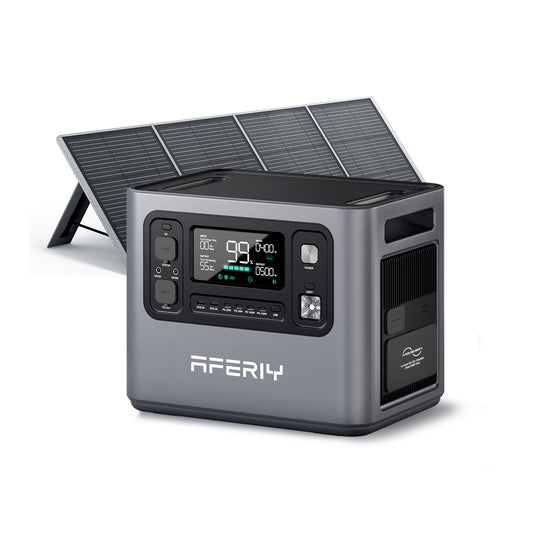
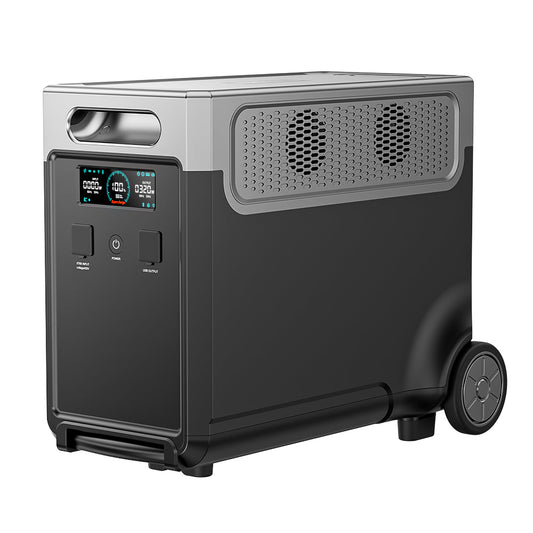
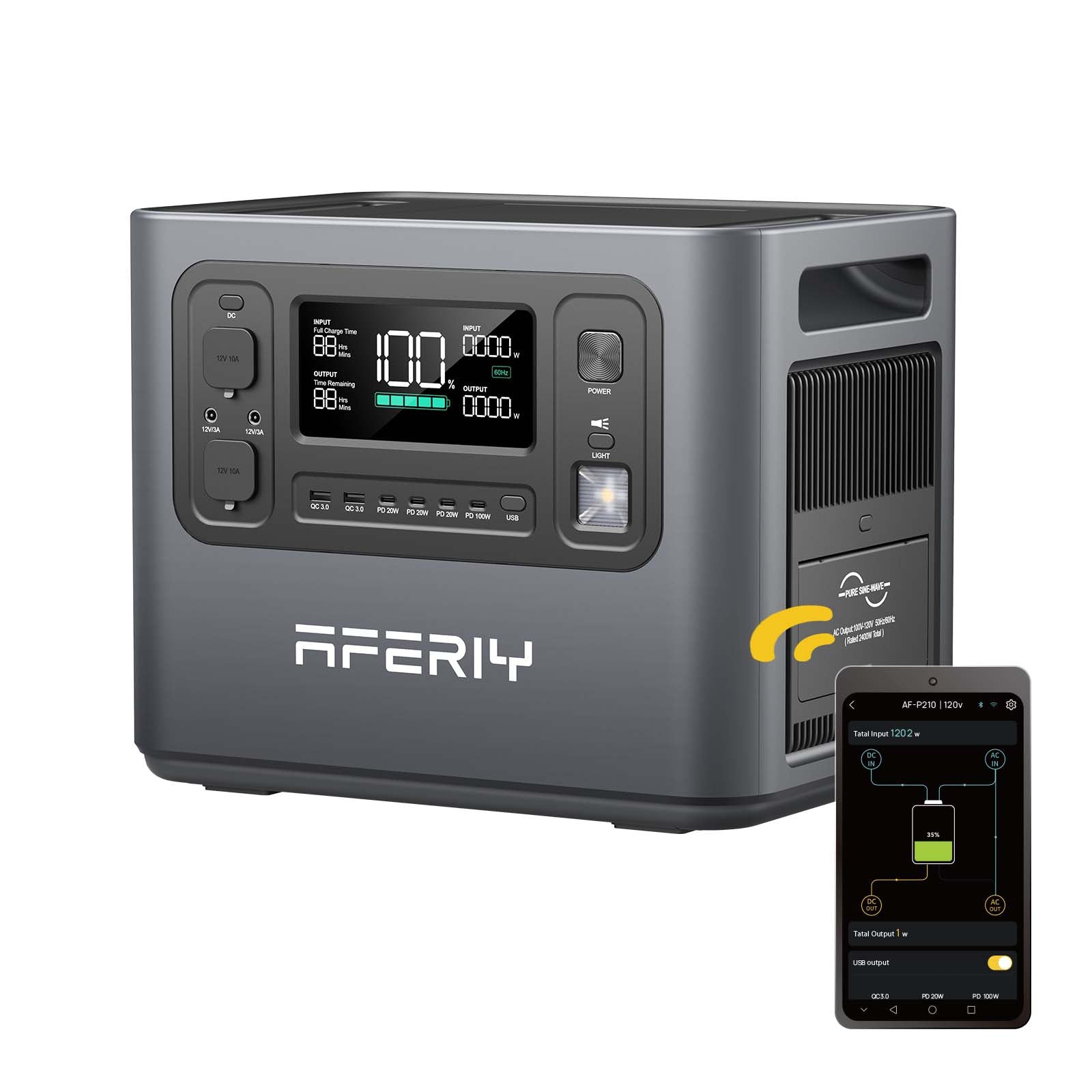
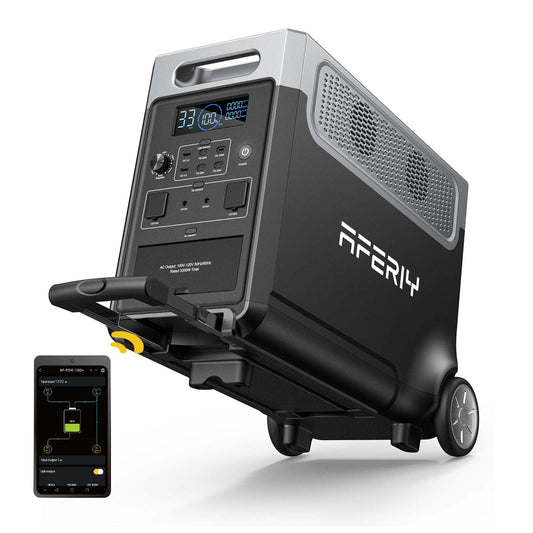
For instance, a middle-capacity device, just like the AFERIY P280 portable power station(about 2kWh), can deal with necessary equipment when short power cuts happen, while a larger-capacity product, such as the AFERIY P310 portable power station (about 3.8kWh), is more suitable for giving power to many electric tools or offering longer backup time. Carrying out accurate counting of amperes can prevent you from purchasing a unit that is too small in size.

Quick Reference Table
This reference chart provides immediate amp conversions for common wattages across standard electrical voltages.
|
Power (Watts) |
12V System (DC) |
120V Circuit (AC) |
230V Circuit (AC) |
240V Circuit (AC) |
|
100W |
8.33 A |
0.83 A |
0.43 A |
0.42 A |
|
500W |
41.67 A |
4.17 A |
2.17 A |
2.08 A |
|
1000W |
83.33 A |
8.33 A |
4.35 A |
4.17 A |
|
1500W |
125.00 A |
12.50 A |
6.52 A |
6.25 A |
|
2000W |
166.67 A |
16.67 A |
8.70 A |
8.33 A |
AC vs DC Calculations
Calculating Alternating Current (AC) for complex machines often requires factoring in electrical efficiency, whereas Direct Current (DC) is a straightforward mathematical division.
AC Calculations
For AC circuits with inductive loads (like motors), divide the watts by the product of the volts and the Power Factor (PF).
In AC systems, not all power is used efficiently. The Power Factor represents this efficiency as a decimal between 0.7 and 1.0. For purely resistive loads (like incandescent bulbs), the PF is 1.0. For inductive loads, use this formula:
Amps =Watts/(Volts x PF)
DC Calculations
DC calculations do not use a Power Factor, meaning the standard Watts ÷ Volts formula is completely accurate for battery power stations and solar panels.
Because Direct Current flows in a single direction, power delivery is perfectly efficient. To calculate a 60W radio running on a 12V automotive battery, the math is simply 60 ÷ 12 = 5 Amps.
Common Mistakes to Avoid
Ignoring motor startup surges and disregarding continuous load limits are the most dangerous errors in amp calculations.
-
Ignoring Surge Watts: Motor-driven devices (refrigerators, AC units) require 2 to 3 times their rated "running watts" to start up. You must calculate your maximum amperage based on this high surge requirement, not the lower running draw.
-
Forgetting the 80% Rule: The National Electrical Code dictates that continuous loads (running for 3+ hours) should only load a circuit to 80% capacity. A 20A breaker should continuously carry no more than 16A.
Conclusion
Calculating amps from watts and volts relies on a straightforward division formula: Amps = Watts ÷ Volts.
By accurately finding your device's power rating and matching it to your system's voltage, you instantly uncover the electrical current. Applying this simple math is mandatory for anyone looking to safely wire circuits, prevent overloaded breakers, select the correct wire gauges, and securely invest in properly sized off-grid backup systems.
FAQ
What happens if the amps are too high?
If the electric current that is pulled out goes beyond what the electric wire or circuit breaker can handle, this system will, as a result, produce overheating that brings danger. Protected circuits can make the breaker act to cut off power, while unprotected circuits will let the wire insulation melt and, hence, will very likely cause a fire to start.
Are amps or watts more important?
Neither is more important, as they measure different things. Watts are crucial for determining total energy costs and power capabilities. Amps are crucial for physical safety, dictating the required thickness of wires and the size of circuit breakers.
Is 200W the same as 200Wh?
No. 200W (Watts) is a measure of instantaneous power, showing exact energy demand at a given second. 200Wh (Watt-hours) measures energy storage over time, indicating a battery could sustain a 200-watt device continuously for exactly one hour before dying.
 Free shipping from US local warehouse