













How do you calculate amps from watts and volts?
Understanding the relationship between watts, volts, and amps is important when evaluating the electrical requirements of appliances, power systems, and backup equipment. Whether you want to determine how much current an appliance draws, compare different voltage systems, or evaluate a portable power station, knowing how to calculate amps can help you understand your power needs and avoid incorrect capacity estimates.
The calculation is straightforward, but the appropriate method can vary between DC and AC systems. This guide explains how to calculate amps from watts and volts, provides practical examples and a conversion chart, and covers the key differences between DC and AC calculations, including when power factor needs to be considered.
How to Calculate Amps From Watts and Volts
The relationship between power, voltage, and current can be expressed using Watt's Law: Watts = Volts × Amps. When you know the power and voltage, you can rearrange this formula to determine the current: Amps = Watts ÷ Volts. To make the calculation, identify the device's power rating in watts and its operating voltage, then divide the wattage by the voltage. For example, a 1,500W space heater operating at 120V draws 1,500W ÷ 120V = 12.5A. If the power rating is given in kilowatts, convert it to watts first; for example, 1.5kW = 1,500W.
Voltage also has a direct effect on current. A 1,000W load requires about 83.3A at 12V, but only 8.33A at 120V. This means the same amount of power requires more current at a lower voltage and less current at a higher voltage. Understanding this relationship is especially useful when evaluating household appliances, battery systems, and portable power equipment, where the operating voltage and power rating determine the expected current draw.
How to Calculate Amps for AC and DC
For a simple DC circuit, current is calculated by dividing power by voltage:
Amps = Watts ÷ Volts
For example, a 600W DC load operating at 12V draws 600 ÷ 12 = 50A.
For single-phase AC, the calculation can also depend on power factor. The relationship between real power, voltage, current, and power factor is:
Amps = Watts ÷ (Volts × Power Factor)
For a resistive AC load with a power factor of 1, such as a basic electric heater, this produces the same result as dividing watts by volts. For a 1,500W load at 120V with a power factor of 0.8, the current would be approximately 1,500 ÷ (120 × 0.8) = 15.63A. Electrical references use this power-factor-adjusted formula for single-phase AC calculations.
For a balanced three-phase AC system using line-to-line voltage, the formula is:
Amps = Watts ÷ (√3 × Volts × Power Factor)
where √3 is approximately 1.732. For example, a 10,000W three-phase load at 480V with a power factor of 0.9 draws approximately 13.37A. Three-phase calculations are mainly relevant to commercial and industrial electrical systems; for typical household appliances and portable power stations, the DC or single-phase AC formulas are generally more relevant.
Watts to Amps Conversion Chart
The following table provides quick watts-to-amps calculations for common DC and AC voltages. The AC values assume a power factor of 1, so they represent the basic watts-to-amps relationship rather than every possible AC load.
| Power | 12V DC | 24V DC | 48V DC | 120V AC | 240V AC |
|---|---|---|---|---|---|
| 100W | 8.33A | 4.17A | 2.08A | 0.83A | 0.42A |
| 500W | 41.67A | 20.83A | 10.42A | 4.17A | 2.08A |
| 1,000W | 83.33A | 41.67A | 20.83A | 8.33A | 4.17A |
| 1,500W | 125A | 62.5A | 31.25A | 12.5A | 6.25A |
| 2,000W | 166.67A | 83.33A | 41.67A | 16.67A | 8.33A |
| 3,000W | 250A | 125A | 62.5A | 25A | 12.5A |
For example, a 2,000W load draws 166.67A at 12V, but only 16.67A at 120V. This difference is especially important for low-voltage battery systems, where high-power loads can require substantial current.
The table also shows why voltage should always be considered when comparing electrical systems. A wattage rating by itself does not tell you the current draw unless the operating voltage is known.
Calculating Amps for Appliances and Backup Power
Calculating amps becomes more useful when you apply the formula to real appliances and backup power systems. The current draw of an appliance helps determine whether a circuit or power station can handle the load, while its wattage and operating time can be used to estimate how much battery capacity is required.
Calculating the Load of Multiple Appliances
When multiple appliances operate at the same voltage, you can calculate the current for each device and add the values to estimate the combined load. For example, a 1,200W microwave operating at 120V draws 10A, while an 800W coffee maker draws about 6.67A. Running both at the same time would create an estimated load of 16.67A.
The same approach can be used when checking whether several devices are suitable for a portable power station. However, the total running wattage must remain within the power station's rated AC output, and motor-driven appliances may require additional startup power.
Using Watt-Hours to Estimate Runtime
When choosing a portable power station, amps indicate current, watts indicate power, and watt-hours indicate stored energy. Once you know an appliance's wattage, you can estimate its runtime based on the battery capacity and the appliance's average power consumption. Because power stations experience energy losses during power conversion, a practical runtime estimate should account for usable battery capacity rather than assuming that 100% of the rated capacity reaches the appliance.
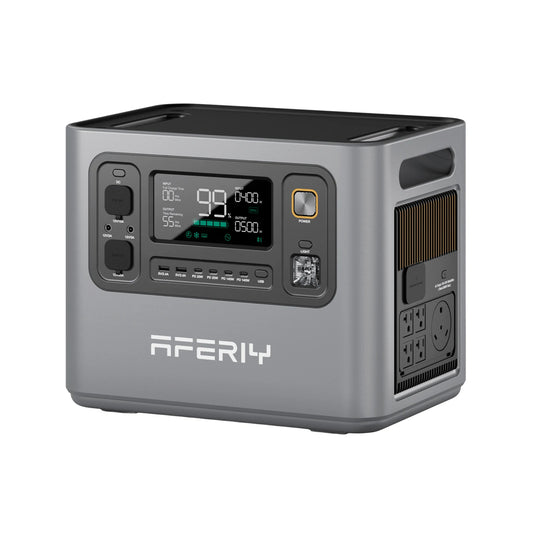
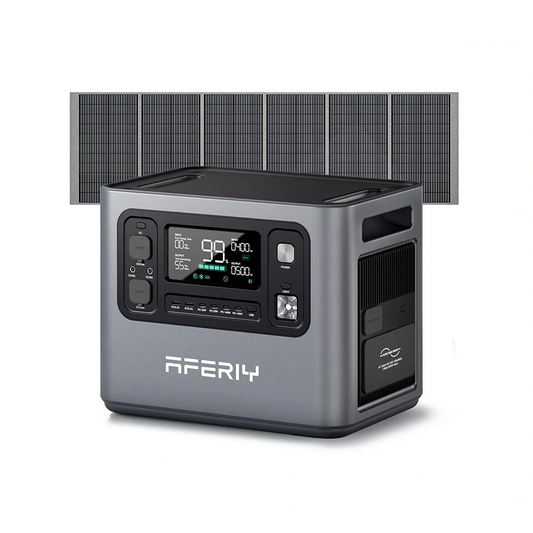
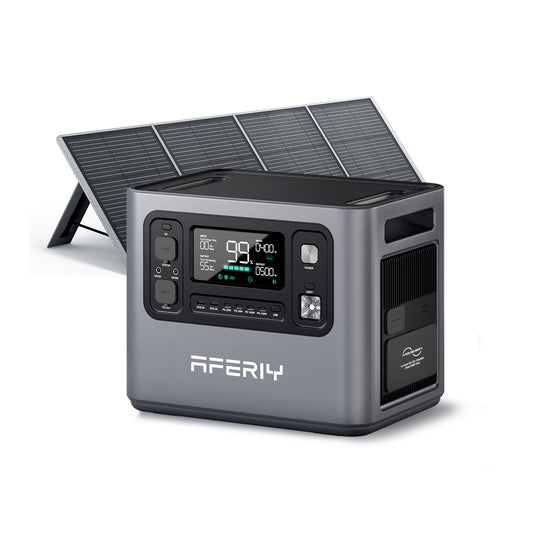
For example, the AFERIY P180 Pro Portable Power Station has a 1,024Wh battery capacity and a rated 1,800W AC output. AFERIY's general runtime estimate uses 85% of the rated battery capacity. For a 200W appliance, the estimated runtime is approximately 1,024Wh × 85% ÷ 200W = 4.35 hours. This provides a practical estimate under the stated conditions, although actual runtime can vary depending on the appliance's power consumption, temperature, battery condition, and other factors.

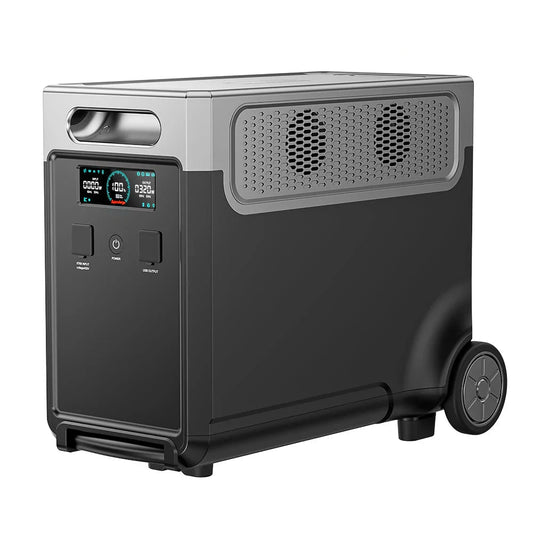
For higher-power or longer-duration backup, the AFERIY P300 Portable Power Station provides 2,048Wh of battery capacity and 3,000W of rated AC output, with capacity expandable up to 10,240Wh. Using the same 85% estimation method, a 500W load would provide an estimated runtime of approximately 2,048Wh × 85% ÷ 500W = 3.48 hours. Increasing the P300's battery capacity with compatible expansion batteries can extend potential runtime, while its rated 3,000W AC output remains unchanged.

Consider Running and Starting Power
Runtime calculations are based on average power consumption, but appliances do not always draw the same amount of power continuously. Refrigerators, air conditioners, pumps, compressors, and some power tools can require substantially more power when starting than when running normally.
When selecting a portable power station, therefore, check both the appliance's running wattage and starting or surge requirement. A power station needs sufficient output capacity to handle the appliance, while a larger battery capacity mainly provides longer runtime.
Common Mistakes When Calculating Amps
A watts-to-amps calculation is simple, but using the wrong values or ignoring the type of load can lead to inaccurate results.
Using the Wrong Voltage
The same power can produce very different current levels at different voltages. For example, a 1,000W load draws 83.3A at 12V but only 8.33A at 120V. Always use the actual operating voltage of the device or circuit.
Ignoring Power Factor
For DC circuits and resistive AC loads, Amps = Watts ÷ Volts is appropriate. For AC loads such as motors and compressors, power factor can affect the current, so the calculation should include it: Amps = Watts ÷ (Volts × Power Factor).
Overlooking Startup Power
Some appliances require more power when starting than during normal operation. Refrigerators, air conditioners, pumps, and power tools may therefore have a higher startup or surge requirement than their running wattage suggests. When choosing a portable power station or inverter, check both running and starting power.
FAQ
What happens if the amps are too high?
If a circuit carries more current than its wiring or protective devices are designed to handle, the wiring can overheat. A properly protected circuit may trip its breaker or blow a fuse, while an overloaded or improperly protected circuit can create a fire hazard.
Can high amps damage an appliance?
High current does not necessarily mean an appliance will be damaged, because a device draws current according to its electrical design and operating voltage. However, using the wrong voltage or exceeding the rated capacity of the circuit or power source can cause overheating, malfunction, or damage. Check the appliance's rated voltage and power requirements before connecting it to a power source.
Can I use calculated amps to choose a breaker or wire?
Not by itself. A watts-to-amps calculation provides an estimate of load current, but wire and breaker selection can also depend on continuous loads, conductor specifications, installation conditions, other connected loads, and applicable electrical codes. Use the equipment specifications and relevant electrical requirements when sizing a circuit.
Conclusion
Calculating amps from watts and volts is straightforward: Amps = Watts ÷ Volts. By checking the device's power rating and operating voltage, you can estimate its current draw and better understand the load on a circuit or backup power system. For appliances and portable power stations, this calculation can also help you compare power requirements and choose equipment that can handle the load safely.
 Free shipping from US local warehouse