













Black Friday Power Station Buying Guide 2026: What to Check
Black Friday is a good opportunity to compare portable power stations, but a big discount doesn’t always mean better value. The right choice depends on your power needs, battery capacity, output, charging options, and long-term costs.
With Black Friday falling on November 27, 2026, now is the time to shortlist suitable models and track their prices before deals go live. This guide covers how to calculate your power needs, spot genuine savings, and evaluate solar bundles so you can make a more informed purchase when offers arrive.

Calculate Your Power Needs Before Black Friday
Before comparing Black Friday deals, estimate how much energy your appliances consume. Battery capacity (Wh) determines potential runtime, while continuous AC output (W) determines which appliances the power station can run.
Example: How Much Battery Capacity Do You Need for a 12-Hour Outage?
Suppose you want to power a refrigerator, Wi-Fi router, and LED lamp during a 12-hour outage.
| Device | Assumed average power | Energy used in 12 hours |
|---|---|---|
| Refrigerator | 62.5W | 750Wh |
| Wi-Fi router | 10W | 120Wh |
| LED lamp | 10W | 120Wh |
| Total | 82.5W | 990Wh |
These are illustrative average loads, not universal appliance ratings. Refrigerator consumption varies by model and usage, so check its actual energy consumption when possible.
To account for conversion losses, use this planning formula:
Required battery capacity = Energy demand ÷ Usable-energy factor
Assuming 85% of rated capacity is usable: 990Wh ÷ 0.85 ≈ 1,165Wh
A 1,024Wh power station would fall short of this estimated requirement, while a 2,048Wh model would provide more headroom. Actual runtime may be lower due to inverter losses and changing appliance loads.
Estimate Runtime at Different Power Levels
For a 2,048Wh power station, assuming 85% usable energy, approximately 1,741Wh is available for this calculation.
| Average load | Estimated runtime |
|---|---|
| 100W | 17.4 hours |
| 300W | 5.8 hours |
| 500W | 3.5 hours |
| 1,000W | 1.7 hours |
These are theoretical estimates, excluding additional inverter overhead and startup surges. Use your expected energy demand to shortlist suitable models before comparing Black Friday prices.
Compare Battery Capacity, Output, and Charging Specifications
Battery Capacity and Expansion
A 2,048Wh power station offers twice the rated battery capacity of a 1,024Wh model, potentially providing twice the runtime under equivalent conditions. However, expansion batteries are worth the extra cost only if you expect to need additional storage.
Continuous Output and Startup Power
A power station rated at 1,000W cannot continuously power a 1,500W appliance, regardless of battery capacity. Appliances with motors or compressors may also require higher startup power.
Check the continuous output, surge rating, and combined running wattage of the devices you intend to operate simultaneously.
Battery Chemistry and Cycle Life
LiFePO₄ batteries are worth considering when evaluating long-term value. AFERIY lists the P210, P280, and P310 Portable Power Station with LiFePO₄ batteries rated for 4,000+ charge-discharge cycles under the manufacturer’s stated conditions.
Cycle life is not a guaranteed number of years. Actual battery longevity depends on temperature, charging habits, depth of discharge, and operating conditions.
AC Charging Speed
Charging input affects how quickly you can replenish the battery. AFERIY lists maximum AC charging inputs of 1,100W for the P210 and 1,800W for the P280. Actual charging time depends on the charging curve, temperature, and operating settings.
Check the exact model specifications rather than assuming that power stations with similar capacities recharge at the same speed.
How to Tell Whether a Black Friday Discount Is Worth It
Compare a product’s selling price with reliable price history instead of relying solely on its advertised discount.
Example: Advertised Discount vs. Recent Selling Price
Consider this hypothetical listing:
| Price reference | Example price |
|---|---|
| Advertised original price | $1,099 |
| Hypothetical Black Friday price | $640 |
| Typical recent selling price | $800 |
| Previous 90-day low | $699 |
Compared with the advertised original price: ($1,099 − $640) ÷ $1,099 × 100 ≈ 41.8% off
Compared with the typical recent selling price: ($800 − $640) ÷ $800 × 100 = 20% off
The hypothetical offer is also 8.4% below the previous 90-day low of $699.
These figures are illustrative, not actual AFERIY or competitor prices. To evaluate a real offer, compare the same model’s price history and current prices from reputable sellers.
Compare Cost per Watt-Hour
Cost per Wh helps compare battery capacity relative to price:
Cost per Wh = Purchase price ÷ Rated battery capacity
| Specification | Model A | Model B |
|---|---|---|
| Rated capacity | 1,024Wh | 2,048Wh |
| Purchase price | $500 | $800 |
| Cost per Wh | $0.49 | $0.39 |
Model B costs 60% more but offers twice the capacity, making its cost per Wh approximately 20% lower. However, the larger battery is not necessarily better value if you do not need the additional energy.
Track Prices Before Buying
For each shortlisted model, record:
- Its exact model number and regular selling price.
- The lowest verifiable historical price.
- Prices from the manufacturer’s store and other reputable sellers.
- Whether the offer includes solar panels, expansion batteries, or other accessories.
Compare identical product configurations on the same day. A bundle should not be compared directly with a standalone power station.
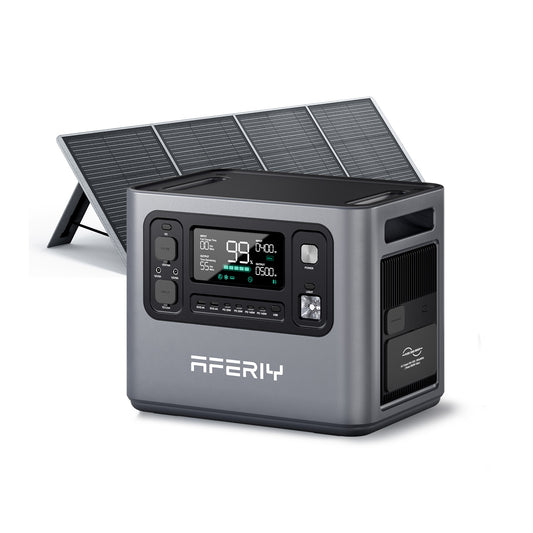
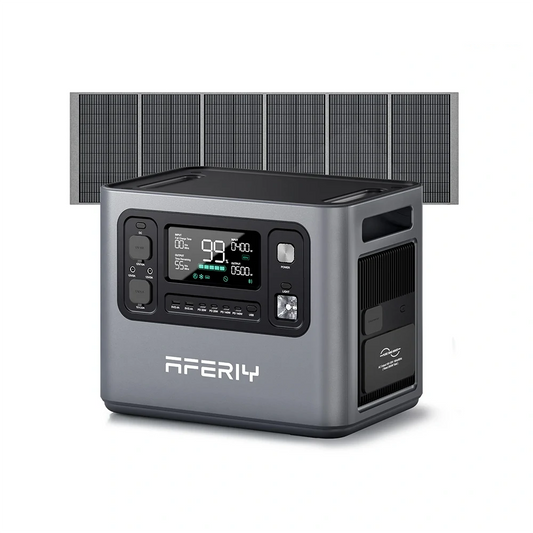
Are Black Friday Solar Generator Bundles Worth It?
Solar generator bundles can be useful for camping, off-grid stays, and extended outages. Their value depends on whether you need solar charging, whether the equipment is compatible, and how much energy the panels can realistically generate.
Estimate Solar Panel Output
Actual solar production depends on sunlight, shading, panel orientation, temperature, and system losses.
Assume a 400W panel operates at an average of 75% of its rated output over four peak-sun hours: 400W × 0.75 × 4 hours = 1,200Wh per day. If charging efficiency is assumed to be 85%: 1,200Wh × 0.85 = 1,020Wh stored. That is approximately 50% of a 2,048Wh battery’s rated capacity. These are planning estimates, not guaranteed daily production or charging results.
Check Solar Compatibility
Before choosing a bundle, verify:
Input voltage and current: The panel configuration must fall within the power station’s supported input range.
Maximum solar input: The power station may not accept the full rated output of every connected panel.
Connectors and configuration: Check connector compatibility and whether the panels must be connected in series or parallel.
Compare Bundle Prices
Suppose a hypothetical bundle includes a power station and a 400W solar panel for $1,000. If the power station costs $800 and the same compatible panel costs $250 separately, the standalone total is $1,050.
The bundle saves $50, or approximately 4.8% compared with buying the components separately.
These are illustrative prices, not current offers. When comparing actual bundles, confirm the included accessories and compare prices on the same day. If you already own a compatible panel, buying another may not provide additional value.
AFERIY Power Stations to Watch for Black Friday 2026
Looking for a portable power station this Black Friday? These AFERIY models offer different combinations of output power, battery capacity, smart controls, and expansion options for home backup and outdoor use.
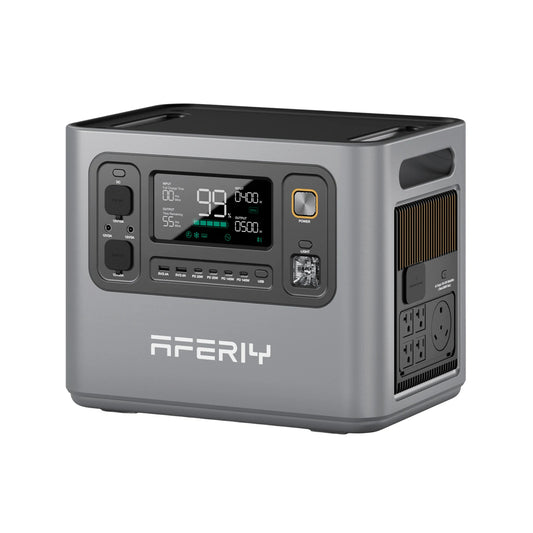
AFERIY P210 Portable Power Station: Smart Power for Home and Outdoor Use
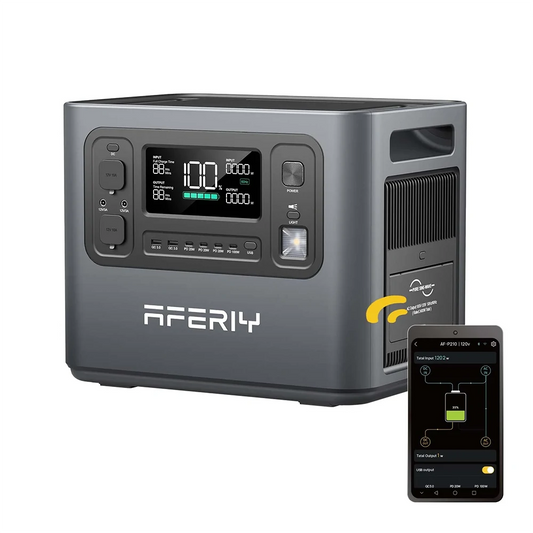
The AFERIY P210 Portable Power Station combines 2,048Wh of LiFePO₄ battery capacity with 2,400W of pure sine wave AC output. Its app control lets you monitor power usage and manage compatible outputs from your phone, while its UPS function switches to battery power in less than 10ms during a grid outage. With 16 output ports and support for up to 500W of solar input, it is worth considering for essential home appliances, electronics, camping, and RV trips.

AFERIY P280 Portable Power Station: Expandable Power for Changing Needs
The AFERIY P280 Portable Power Station delivers 2,800W of continuous output and 2,048Wh of starting capacity, expandable up to 10,240Wh. It supports up to 1,200W of solar input and 1,800W of AC charging input, making it a strong option for users who need higher output, faster recharging, or additional storage for longer outages. Its expansion capability also provides flexibility as your backup power needs grow.

AFERIY P300 Portable Power Station: Higher Output for Multiple Appliances
With 3,000W of continuous output, 2,048Wh of battery capacity, and expansion up to 10,240Wh, the AFERIY P300 Portable Power Station is designed for users who need more output while retaining the option to increase storage. Wi-Fi and Bluetooth connectivity enable app-based monitoring and control, while solar charging supports off-grid use. Consider it for home backup, outdoor activities, and powering multiple compatible appliances within its rated limits.

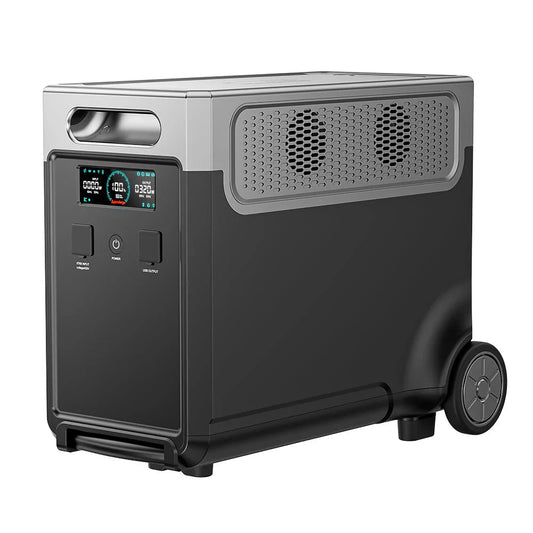
AFERIY P310 Portable Power Station: High-Capacity Power for Longer Backup
The AFERIY P310 Portable Power Station offers 3,840Wh of battery capacity, 3,600W of continuous output, and expansion up to 11,520Wh. With up to 2,000W of solar input and 2,200W of AC charging input, it is worth considering for longer backup periods and higher-demand power needs. Its larger starting battery can provide more runtime than the 2,048Wh models at the same load, while expansion offers additional flexibility.

Build Your Black Friday Shopping Checklist
You can complete most of your research before promotional offers appear. Use the following checklist to compare products consistently.
Calculate energy demand: Estimate the watt-hours needed for your essential devices and intended runtime.
Check output requirements: Confirm continuous output and startup capability for your appliances.
Set a budget: Include the cost of any solar panels, expansion batteries, or accessories you genuinely need.
Shortlist two or three models: Record their capacity, output, weight, charging specifications, and warranty.
Track regular prices: Record actual selling prices rather than relying only on advertised original prices.
Compare cost per Wh: Use this as a supporting metric alongside output, battery chemistry, and warranty.
Verify solar compatibility: Check voltage, current, maximum input, and connectors before buying a bundle.
Check the seller: Confirm that the seller is authorized and that the warranty applies to the purchase.
Review return terms: Check the applicable return window and test the unit promptly after delivery.
Conclusion
A good Black Friday power station deal combines the right capacity, output, and features with a genuinely competitive price. Before November 27, shortlist suitable models, track their prices, and compare the full configuration when offers become available. Check the AFERIY official website for confirmed Black Friday offers.
 Free shipping from US local warehouse