













How to Convert Watts to Amps: Formula, Examples & Conversion Chart
If you know how many watts an appliance uses but need to determine its current draw, you can convert watts to amps with a simple formula. The key is knowing the voltage.
The basic formula is:
Amps (A) = Watts (W) ÷ Volts (V)
For example, a 1,500W appliance connected to a 120V supply would draw:
1,500W ÷ 120V = 12.5A
This calculation is useful for understanding appliance ratings, estimating electrical loads, and checking whether a generator, inverter, or portable power station can support a device.

Watts, Amps, and Volts Explained
Watts, amps, and volts describe different parts of an electrical system.
- Watts (W) measure electrical power.
- Amps (A) measure electrical current.
- Volts (V) measure voltage.
They are connected by the basic power equation:
Watts = Volts × Amps
From this equation, you can calculate the other values:
Amps = Watts ÷ Volts
Watts = Amps × Volts
Volts = Watts ÷ Amps
This is why there is no single watts‑to‑amps conversion without knowing voltage. A 600W load at 120V is 5A, while the same 600W load at 240V is 2.5A.
The power is unchanged, but the current is different because the voltage is different.
How to Convert Watts to Amps
DC Watts to Amps
For a DC circuit, use:
Amps = Watts ÷ Volts
Suppose a 240W device operates at 12V:
240W ÷ 12V = 20A
At 24V, the same 240W load would be:
240W ÷ 24V = 10A
This relationship is particularly useful for batteries, solar equipment, RV systems, and other low‑voltage applications.
Single‑Phase AC Watts to Amps
For a single‑phase AC load with a power factor of 1, the basic calculation is:
Amps = Watts ÷ Volts
Using a 120V U.S. household supply, a 1,500W load gives:
1,500W ÷ 120V = 12.5A
For AC loads with a power factor below 1, a more complete calculation is:
Amps = Watts ÷ (Volts × Power Factor)
For example, a 1,000W load at 120V with a power factor of 0.9 would draw approximately:
1,000 ÷ (120 × 0.9) ≈ 9.26A
For everyday appliance estimates, the basic W ÷ V calculation is often sufficient when power factor is not provided, but motor‑driven and inductive equipment may require the more complete calculation.
Three‑Phase AC Watts to Amps
Three‑phase systems use a different formula. For a balanced three‑phase load using line‑to‑line voltage:
Amps = Watts ÷ (√3 × Volts × Power Factor)
For example, a 9,000W load at 480V with a power factor of 0.85 would be:
9,000 ÷ (1.732 × 480 × 0.85) ≈ 12.73A
Three‑phase calculations are more relevant to commercial and industrial equipment than typical household appliances. When working with three‑phase equipment, use the voltage and electrical ratings specified by the manufacturer.
Watts to Amps Conversion Chart
The following chart uses the basic Amps = Watts ÷ Volts calculation for common voltage levels. For AC equipment with a power factor below 1, actual current can be higher than the simple calculation suggests.
| Power | 12V | 24V | 120V | 240V |
|---|---|---|---|---|
| 100W | 8.33A | 4.17A | 0.83A | 0.42A |
| 250W | 20.83A | 10.42A | 2.08A | 1.04A |
| 500W | 41.67A | 20.83A | 4.17A | 2.08A |
| 750W | 62.50A | 31.25A | 6.25A | 3.13A |
| 1,000W | 83.33A | 41.67A | 8.33A | 4.17A |
| 1,500W | 125A | 62.50A | 12.50A | 6.25A |
| 2,000W | 166.67A | 83.33A | 16.67A | 8.33A |
| 3,000W | 250A | 125A | 25.00A | 12.50A |
The difference between voltage levels is easy to see. A 1,000W load is about 83.33A at 12V but only 8.33A at 120V. At 240V, the same load is about 4.17A.
These figures are mathematical conversions. They should not be used by themselves to determine wire, fuse, or circuit‑breaker sizing.
How to Convert From Amps to Watts
The same relationship can be reversed. To convert from amps to watts, multiply amps by volts:
Watts = Amps × Volts
For example, an appliance drawing 10A from a 120V supply would have a calculated power of:
10A × 120V = 1,200W
At 240V, 10A would correspond to:
10A × 240V = 2,400W
This is why both current and voltage are needed when you convert amps to watts.
The reverse calculation can also be useful for checking specifications. If a device is listed as 1,200W and 10A:
1,200W ÷ 10A = 120V
This provides a quick way to verify the relationship among the three ratings.
Common Mistakes When Converting Watts to Amps
A watts‑to‑amps calculation is simple, but several common mistakes can lead to an incorrect result.
Using the Wrong Voltage
The voltage must match the appliance or electrical system being evaluated. For example, a 1,200W load calculates to 10A at 120V but 5A at 240V. Using the wrong voltage can therefore double or halve the calculated current.
Ignoring Power Factor
For many basic calculations, Amps = Watts ÷ Volts provides a useful estimate. However, AC equipment with a power factor below 1 can draw more current than this simple calculation suggests. Motors, compressors, and some electronic equipment may require the power factor to be included.
Confusing Watts With Watt‑Hours
Watts describe the rate at which a device uses power, while watt‑hours measure stored or consumed energy over time. A 1,000W appliance does not necessarily consume 1,000Wh every time it operates; running it for one hour would use approximately 1,000Wh before accounting for system losses.
Using Running Power as the Only Rating
Some appliances require additional power when starting. Refrigerators, air conditioners, pumps, and power tools can have higher startup requirements than their normal running wattage. When selecting a generator or portable power station, compare both the continuous and peak output ratings with the appliance’s requirements.
Watts to Amps Examples for Common Appliances
The watts‑to‑amps formula is easier to understand when applied to real appliances. Assuming a 120V supply, divide watts by volts:
Amps = Watts ÷ Volts
1,500W Space Heater
A 1,500W space heater operating at 120V draws:
1,500W ÷ 120V = 12.5A
This is a substantial load, especially if other appliances are running on the same circuit. Always check the appliance and circuit ratings before use.
900W Microwave
A 900W microwave at 120V draws:
900W ÷ 120V = 7.5A
The calculation shows why appliances with different wattage ratings can place very different demands on the same circuit. When checking an appliance label, use the manufacturer’s stated electrical input where available.
60W Light Bulb
A 60W light bulb at 120V draws:
60W ÷ 120V = 0.5A
This is a much smaller load than a heater or microwave. Adding the wattage of several low‑power devices can help estimate their combined demand.
Portable Power Station
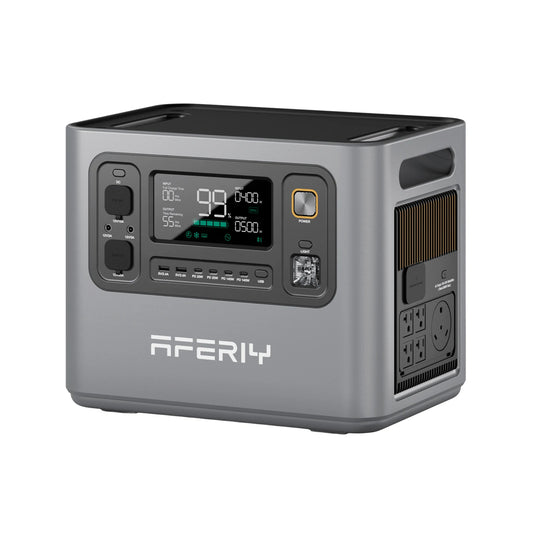
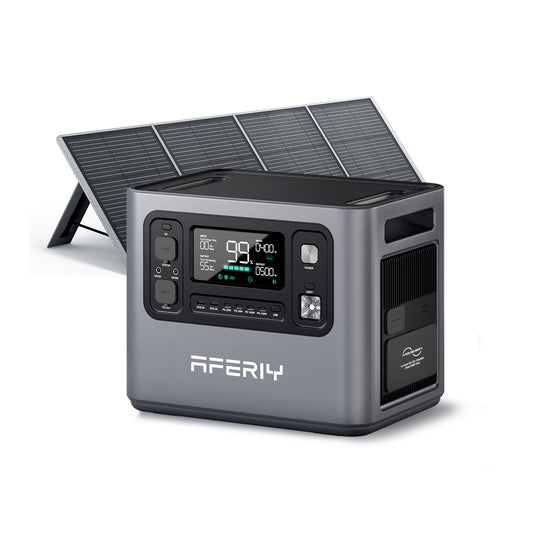
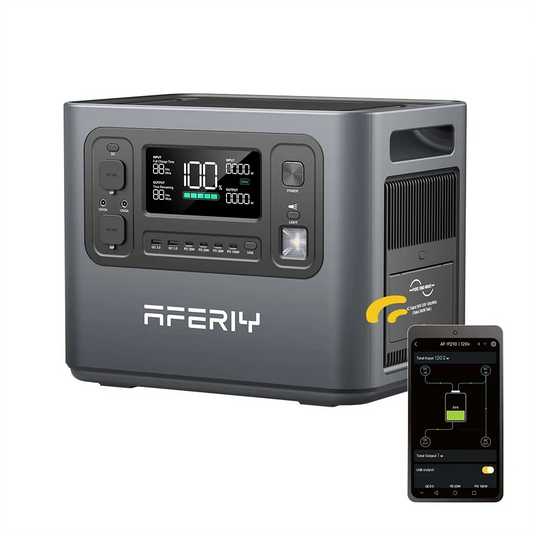
The same calculation can help when checking whether a portable power station can support an appliance. The AFERIY P180 Pro Portable Power Station combines 1,800W of continuous AC output with a 1,024Wh LiFePO4 battery, making it suitable for running a range of household appliances and outdoor equipment within its rated output.
For a 1,200W appliance connected to its 120V AC output:
1,200W ÷ 120V = 10A
The appliance draws approximately 10A, which is below the P180 Pro’s 1,800W continuous AC output. Its 1,024Wh capacity serves a different purpose: watts indicate the power the station can deliver, while watt‑hours indicate the energy stored in the battery.
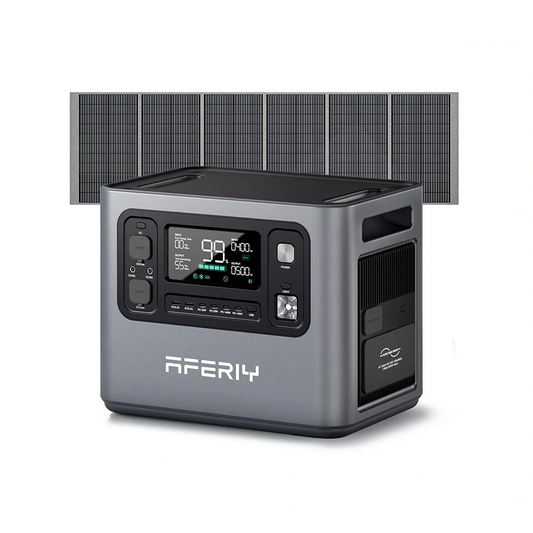
For camping or emergency backup, the AFERIY P180 Pro Portable Power Station can also be paired with portable solar panels. Its solar charging input accepts up to 500W, allowing solar energy to replenish the battery when grid power is unavailable. A portable power station used with solar panels as its charging source is commonly marketed as a solar generator.

Refrigerators and Motor‑Driven Appliances
A refrigerator may have a relatively modest running wattage but require additional power when its compressor starts. The same consideration applies to freezers, pumps, air conditioners, and some power tools.
For these appliances, the watts‑to‑amps calculation provides the running current, but the manufacturer’s running and starting specifications should also be checked before selecting a generator, inverter, or portable power station.
FAQs
What is power factor in a watts‑to‑amps calculation?
Power factor describes the relationship between real power and apparent power in an AC circuit. Resistive loads such as heaters typically have a power factor close to 1, while motors and other inductive loads can have a lower value. When the power factor is below 1, more current is required to deliver the same amount of real power.
Can watts‑to‑amps calculations help with circuit planning?
They can provide an estimate of current demand, but they should not be used by themselves to determine wire size, breaker size, or other electrical installation requirements. For electrical work, use the applicable electrical code and equipment specifications and consult a qualified professional when required.
Can I convert watts to amps from an appliance label?
Yes, if the label provides the appliance’s wattage and rated voltage. Use the electrical input rating when available, since some specifications may refer to output power rather than the electricity the appliance actually draws.
Is a higher‑wattage appliance always more expensive to operate?
Not necessarily. Electricity costs depend on both power consumption and operating time. A high‑wattage appliance used for a short period may consume less energy than a lower‑wattage appliance that operates continuously. Energy consumption is normally measured in kilowatt‑hours (kWh).
Conclusion
To convert watts to amps, divide watts by volts for a basic load. To convert from amps to watts, multiply amps by volts. The voltage must always be known before making the calculation.
For U.S. household equipment, 120V is the most useful reference point for everyday examples, while 12V and 24V are important for battery‑based systems and 240V is relevant to higher‑voltage equipment. Once the relationship between watts, amps, and volts is clear, appliance ratings and portable power specifications become much easier to interpret.
 Free shipping from US local warehouse