












How Many Amps Does a Microwave Use? A Complete Guide
Whether you’re replacing an old microwave, planning a kitchen remodel, preparing for a power outage, or choosing a portable power station for camping, one question often comes up: how many amps does a microwave use?
The answer depends on the microwave’s input power, operating voltage, and efficiency. Although most U.S. household microwaves use a standard 120V outlet, their actual amp draw can vary considerably.
Understanding microwave amps helps you choose the right circuit, avoid overloading outlets, estimate energy consumption, and determine whether a generator or portable power station can run your appliance safely.

How Many Amps Does a Microwave Use?
In most U.S. homes, a microwave typically draws between 5 and 15 amps during normal operation. Compact models usually require less current, while larger countertop or over-the-range units draw more. Commercial microwaves can exceed 15 amps because of their higher input power.
The following table provides a general reference for common household microwaves.
| Microwave Cooking Power | Approx. Amps (120V) | Typical Applications |
|---|---|---|
| 600W | 5–6A | Dorm rooms, small apartments |
| 700W | 6–7A | Compact countertop models |
| 900W | 8–9A | Everyday household use |
| 1000W | 9–11A | Most family kitchens |
| 1200W | 11–13A | Large households |
| 1500W+ | 13–15A+ | Heavy-duty or commercial use |
However, there’s one important detail that many buyers overlook.
The advertised wattage printed on the front of the microwave is usually its cooking (output) power, not the electricity it actually draws from the wall. In reality, the appliance consumes additional power to operate the magnetron, cooling fan, turntable motor, display, and control electronics. As a result, how many amps does a microwave draw is often higher than a simple wattage calculation would suggest.
For example, a microwave marketed as 1000W may actually require 1,400–1,600 watts of input power, resulting in an operating current closer to 12–13 amps rather than 8.3 amps.
How to Calculate Microwave Amps
If you want a more accurate estimate for your specific appliance, the calculation is straightforward.
Formula:
Amps = Watts ÷ Volts
Since standard household voltage in the United States is 120 volts, you simply divide the microwave’s input wattage by 120.
Example 1: 900W Microwave
Input Power: 1,300W
1,300 ÷ 120 = 10.8 amps
Example 2: 1000W Microwave
Input Power: 1,500W
1,500 ÷ 120 = 12.5 amps
Example 3: 1200W Microwave
Input Power: 1,700W
1,700 ÷ 120 ≈ 14.2 amps
The most accurate way to calculate current is to locate the manufacturer’s specification label, usually found on the back of the microwave or inside the door frame. Look for Input Power, Rated Power, or Power Consumption rather than the advertised cooking wattage.
If you’re wondering how much power does a microwave use, remember that input power—not cooking power—is the figure that determines electrical load, generator sizing, and battery runtime.
What Affects How Many Amps a Microwave Uses?
Even microwaves with similar cooking wattage can have different electrical requirements. Several factors influence microwave amps in real-world use.
Microwave Wattage
Higher-wattage microwaves generally draw more current. A compact 700W model may require around 6–8 amps, while a 1200W unit can approach 13–15 amps, offering faster cooking at the cost of higher electricity demand.
Input Power vs. Cooking Power
Cooking power refers to the energy delivered to food, while input power is the electricity drawn from the outlet. Since microwaves are not 100% efficient, always use the input wattage when calculating electrical load or selecting backup power.
Operating Mode and Features
Traditional microwaves regulate lower power settings by cycling the magnetron on and off rather than reducing power continuously. Inverter models provide smoother power control and may improve efficiency during longer cooking cycles. Features such as convection cooking, grilling, or air frying also increase overall power consumption.
Powering a Microwave Anywhere: Home Backup, RVs, and Off-Grid Use
A microwave can consume significant power in a short period, so a suitable backup solution needs more than just battery capacity. A solar generator combines a portable power station with solar panels, allowing users to store energy in the battery and recharge it using sunlight when grid power is unavailable. This makes it especially useful for extended blackouts, RV travel, and off-grid cooking, where access to a wall outlet may be limited.
AFERIY P010 Solar Generator – Best for Small Microwaves and Lightweight Camping
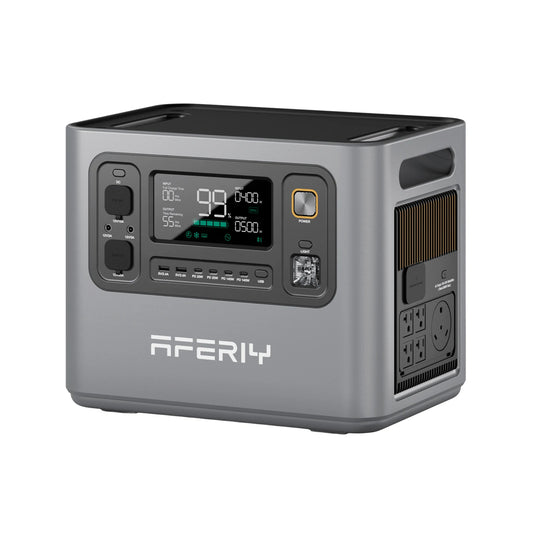
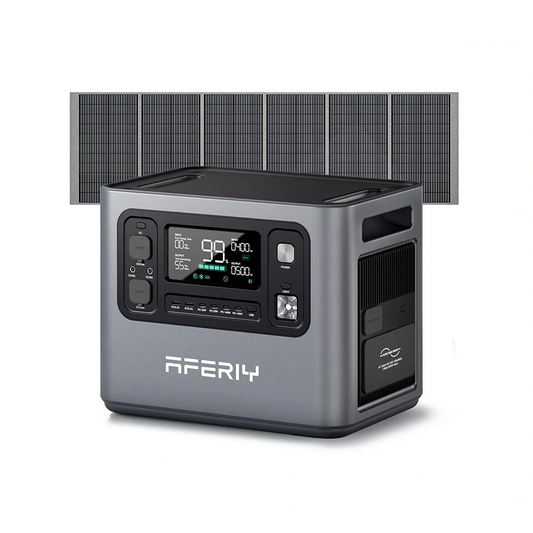
For users who only need occasional microwave use during short camping trips or outdoor activities, a compact solar generator can provide enough power without adding unnecessary weight. The AFERIY P010 Solar Generator is designed for lightweight applications, offering 800W AC output, a 512Wh LiFePO₄ battery, and solar charging support. It is suitable for smaller microwaves and essential devices such as lights, phones, laptops, and small appliances. Its portable design makes it a practical option for weekend camping, road trips, and emergency situations where mobility is more important than maximum capacity.

AFERIY P210 Solar Generator – Best for Home Backup and RV Applications
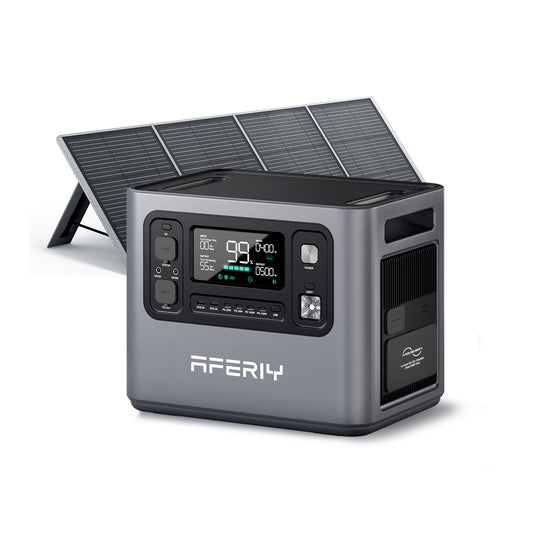
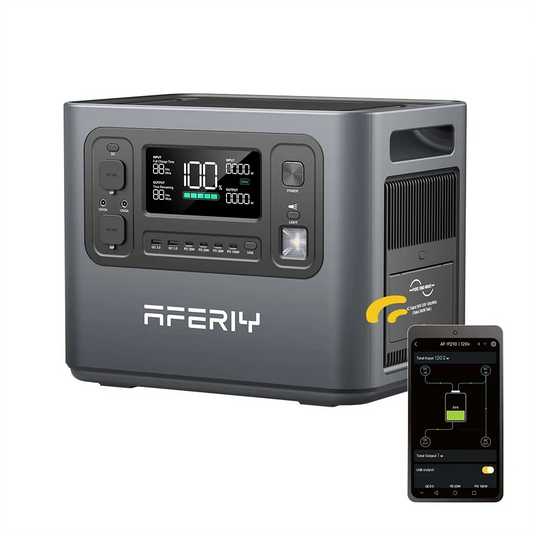
For users who need more than occasional cooking power, a mid-capacity solar generator offers a better balance between output and runtime. The AFERIY P210 Solar Generator delivers 2,400W AC output with a 2,048Wh LiFePO₄ battery, providing enough capacity to run most household microwaves while supporting additional essential devices during power outages. Its larger battery capacity makes it suitable for RV travel, emergency home backup, and outdoor kitchens where users need reliable power for longer periods. With solar charging support, it can continue replenishing energy during extended off-grid use.

AFERIY P310 Solar Generator – Best for Extended Outages and Off-Grid Living
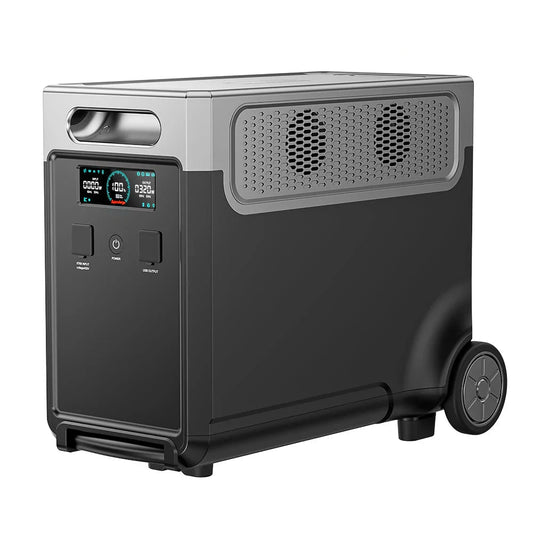
For users who need reliable power for several days, battery capacity becomes just as important as inverter output. The AFERIY P310 Solar Generator is built for demanding backup scenarios with a 3,600W pure sine wave inverter, a 3,840Wh LiFePO₄ battery, and expandable capacity up to 11,520Wh. It can power a microwave while leaving enough capacity for larger appliances such as refrigerators, coffee makers, lighting systems, and other household essentials. With 400W–1,600W solar input support, the P310 is particularly suitable for extended blackouts, off-grid cabins, RV living, and situations where continuous renewable charging is required.

Choosing the right solar generator depends on how often you use your microwave, the appliance’s input power, and how long you need backup energy. Smaller systems are ideal for occasional outdoor use, while higher-capacity solar generators provide greater independence during extended outages and off-grid applications.
Tips to Reduce Microwave Power Consumption
A few simple habits can reduce electricity use and extend battery runtime.
Heat larger portions at once. Reheating several small meals separately often consumes more energy than warming them together.
Use microwave-safe containers with lids. Covering food traps steam and improves heating efficiency, reducing cooking time.
Choose the correct power setting. Defrost and low-power modes can help prevent overcooking. In inverter microwaves, these settings also improve energy efficiency because power is adjusted continuously rather than cycling on and off.
Keep the interior clean. Food residue can absorb microwave energy and reduce heating efficiency over time.
Avoid opening the door repeatedly. Every interruption releases heat, requiring additional cooking time to reach the desired temperature.
FAQs
Can a microwave be on a 15-amp circuit?
Yes, many compact and mid-size countertop microwaves can operate on a 15-amp circuit, provided the circuit isn’t shared with other high-power appliances. However, larger microwaves or over-the-range models often perform better on a dedicated 20-amp circuit to reduce the risk of nuisance breaker trips and ensure reliable operation.
How many amps does a toaster use?
Most household toasters draw 7.5–12.5 amps on a 120V circuit, depending on their wattage. For example, an 800W toaster uses about 6.7 amps, while a 1,500W model draws around 12.5 amps. Because both toasters and microwaves are high-power kitchen appliances, running them on the same circuit at the same time can overload a 15-amp breaker.
Is a 20-amp breaker enough for a microwave?
In most cases, yes. A 20-amp dedicated circuit is recommended for many modern household microwaves because it provides additional capacity for higher input power and startup surges. It also helps prevent breaker trips when the microwave is used frequently or installed as a built-in or over-the-range model.
What size breaker do I need for a 1500-watt microwave?
A 1,500W microwave typically draws about 12.5 amps on a 120V circuit before accounting for startup surge. While some models may operate on a 15-amp circuit, a 20-amp breaker with the correct wire gauge is generally the safer and more reliable choice, especially for dedicated microwave installations. Always follow the manufacturer’s installation requirements.
Conclusion
Most household microwaves draw 8–15 amps on a standard 120V outlet, although the exact current depends on the appliance’s input wattage and efficiency.
To calculate how many amps does a microwave draw, use Amps = Input Watts ÷ Volts and refer to the appliance’s input wattage rather than its cooking power. Understanding how much power does a microwave use helps you choose the right circuit or backup power solution for safe and reliable operation.
 Free shipping from US local warehouse